



Connecting Organizational and Personal Purpose: A Two-Way Journey
What we did
Connecting personal purpose with organizational purpose is the key to mobilizing real commitment and impact
What are you looking for?
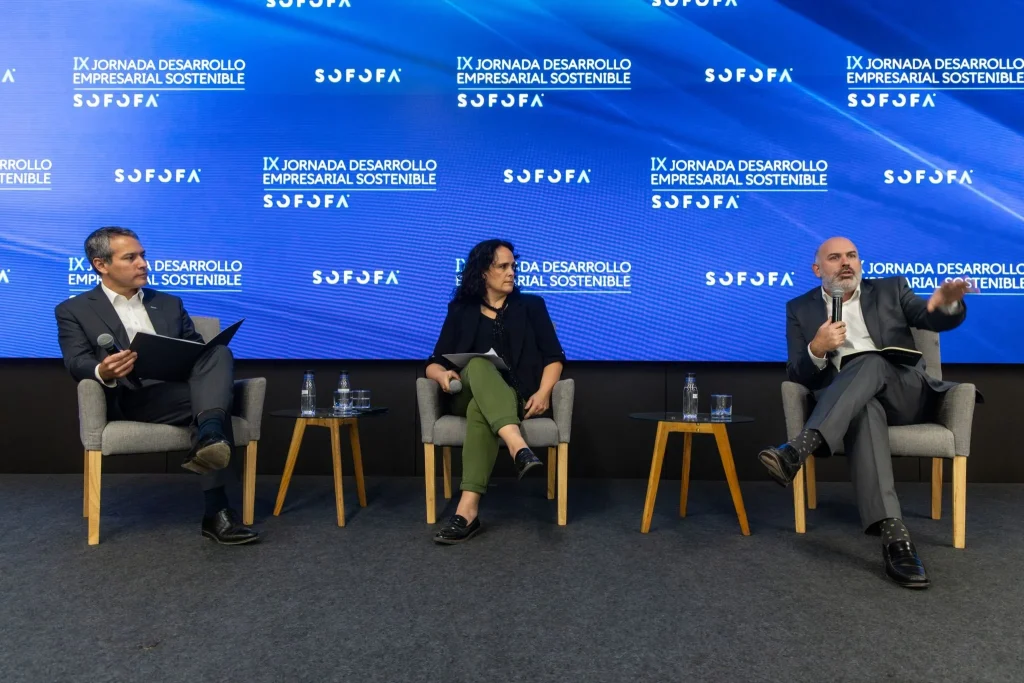
SOFOFA Gathering: Where Should the Private Sector Look to Build Trust?
“The future of work brings us together.”
That was the title of the 9th Sustainable Business Development Conference, organized by SOFOFA, where our partner and CEO Cali Trivelli took part in a panel discussion alongside Roberto Izikson, CEO of CADEM.
The panel was moderated by Rodrigo Yáñez, Secretary General of SOFOFA, who stressed that the organization has two key resources for addressing these issues: our study, conducted jointly with Futuro del Trabajo SOFOFA Capital Humano, the Organizational Trust Pulse, which focuses on how workers perceive trust within their companies, and the Organizational Trust Barometer provided by CADEM.
Both shared their views on how trust is built and redefined within companies in contexts of accelerated change, where Artificial Intelligence (AI) is playing an essential role.
Cali Trivelli delved into a key point: trust is not an abstract attribute, but a concrete construct that is managed day by day within organizations.
“Today, companies face a significant paradox: while the environment demands greater agility, innovation, and technology adoption, people need greater certainty, coherence, and meaning” (Cali Trivelli)
Drawing on the evidence from the Organizational Trust Pulse study, our CEO highlighted that one of the main challenges is closing the gap between what companies say and what their employees actually experience.
“Trust erodes when there is inconsistency. Having a clear purpose is not enough if it doesn’t translate into coherent decisions, leadership, and cultures” (Cali Trivelli)
In this context, the rise of Artificial Intelligence was discussed not only as a productivity tool, but also as a factor that puts pressure on labor relations. Cali Trivelli argued that its adoption must be accompanied by clear ethical frameworks, transparency in its use, and open communication with teams. Technology does not build trust on its own; human decisions about how it is implemented do.
For his part, Roberto Izikson asked why the business trust index fell from 47 points in 2024 to 43 in 2025, breaking a recovery trend that had been underway since the social unrest. “Transparency and how workers are treated are key,” he said. In addition, satisfaction with pay has fallen 20 points since 2019. “Throughout last year, we kept talking about Chile facing a labor emergency, and we haven’t managed to get wages to absorb the impact of the rising cost of living,” he said.
Cali Trivelli called on companies to view trust as a strategic asset, directly linked to business sustainability. In an environment where talent is increasingly critical and demanding, organizations that manage to build trustworthy cultures will have a significant competitive advantage.
The conference included several interactive activities in which an audience of dozens of business leaders gathered to reflect on one of the greatest challenges of our time: how companies prepare, from the top down, for an increasingly dynamic, technological, and demanding future of work.
Almabrands’ participation in this forum reaffirms its commitment to providing evidence, insight, and concrete tools so organizations can face the challenges of the future of work with a people-centered approach.
What we did
Connecting personal purpose with organizational purpose is the key to mobilizing real commitment and impact

What we did
Aaron Hurst explores the shift of purpose from inspirational rhetoric to a strategic imperative, and the key challenge of distinguishing between authentic conviction and mere corporate narrative.

What we did
It All Begins Here
Let's talk
Tell us where you are and let's talk about how to tackle it together.