



Connecting Organizational and Personal Purpose: A Two-Way Journey
What we did
Connecting personal purpose with organizational purpose is the key to mobilizing real commitment and impact
What are you looking for?
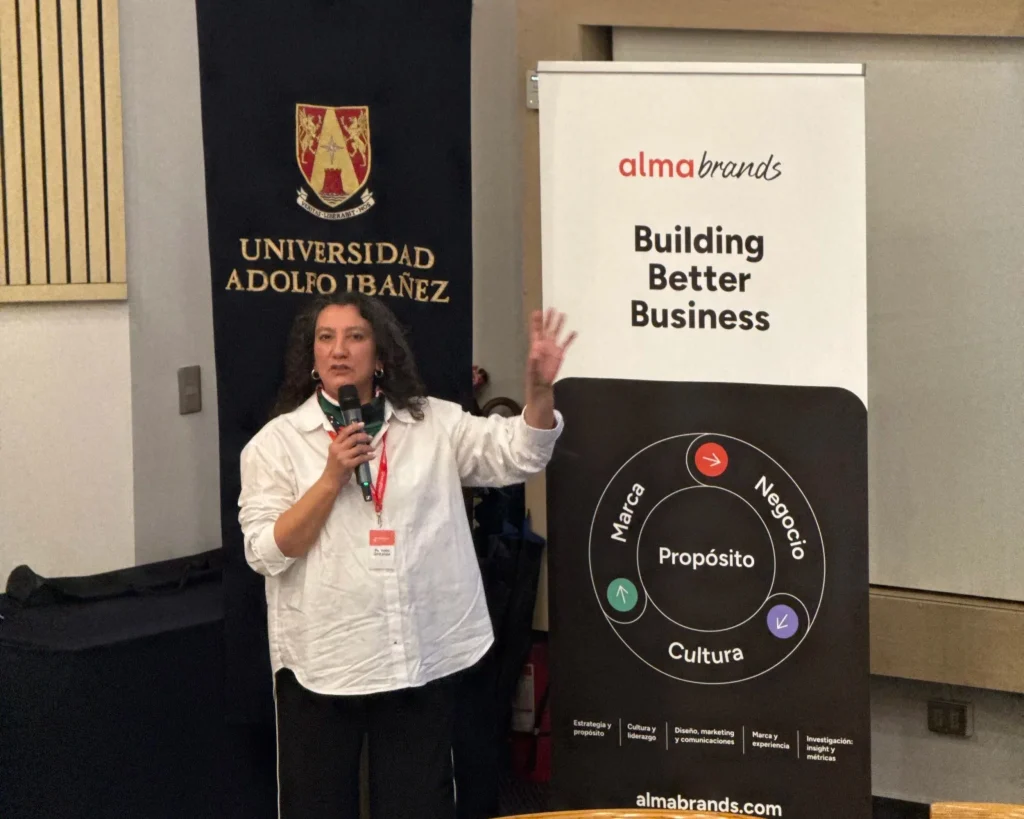
Purpose Doesn’t Fail in Strategy; It Fails in Experience
By Pamela Ordenes, Partner, Almabrands
For years, organizations have sought to define a purpose that allows them to go beyond their own business objectives, and they have undoubtedly made progress in that pursuit: according to Almabrands’ Evolution of Corporate Purpose 2026 study, 87% of Chilean companies report having a defined purpose.
However, the relevant question is no longer whether organizations have a purpose, but whether people actually experience it. Organizations still struggle to activate their purpose and translate it into concrete, consistent experiences for employees, customers, communities, and other stakeholders.
The evidence is clear. While the development of purpose shows relatively high levels of maturity, its implementation continues to lag behind. Only 20% of organizations report having involved all employees in building and implementing it, and 17% say their purpose is activated in processes across the entire organization. Even more concerning, only 11% have recognition and incentive systems linked to purpose activation.
These results reveal a significant gap between intention and experience.
Paradoxically, when purpose is successfully activated, the impact and benefits are clear. On the brand front, 41% report improvements in their corporate image and reputation, 24% see an increase in their employer brand value, and 22% identify greater preference among customers and consumers.
We have purposes that inspire, but that often fail to become experiences. Purposes that are communicated, but not always lived. Purposes that exist in presentations, documents, or internal campaigns, but that have yet to become visible in every everyday interaction.
Three Decisions to Make
The challenge is to turn the brand into the main vehicle for activating purpose, making it visible and tangible in every interaction.
This means, first, designing the brand as an experience that connects purpose with every touchpoint, internal or external. Organizational culture, the employee experience, customer service, supplier relationships, and community ties are all spaces where purpose can become tangible.
Second, it is necessary to go beyond communication. Communicating purpose is important, but not enough; it is vital to bring it to life through experiences and to make those experiences consistent. This is where the brand plays a fundamental role: turning a statement into a concrete lived experience.
And, finally, we must understand that activating purpose is not a one-off action or a limited-time campaign. It requires managing the brand as a living, ongoing system, capable of articulating culture, leadership, experience, value proposition, and business results under a single coherent narrative.
The organizations that achieve the greatest impact are not necessarily those with the most inspiring rhetoric. They are the ones that have made purpose function as a common language running through the entire company. In them, purpose guides innovation, shapes customer relationships, steers leadership, and is reflected in observable behaviors.
In short, the organizations that will thrive in the coming years will be those able to turn their purpose from an aspirational statement into an observable reality and, above all, into a shared experience.
What we did
Connecting personal purpose with organizational purpose is the key to mobilizing real commitment and impact

What we did
Aaron Hurst explores the shift of purpose from inspirational rhetoric to a strategic imperative, and the key challenge of distinguishing between authentic conviction and mere corporate narrative.

What we did
It All Begins Here
Let's talk
Tell us where you are and let's talk about how to tackle it together.